|
My Recording Studio |
|
|
(Homepage
- http://www.shirleyjbutler.ic24.net)
|
|
|
We don't press to vinyl or cut to acetates because quite frankly such media has had it's day. Ok, so they produce a bit more of a warmer sound but, to be honest, I prefer the crispness and clarity of digital recordings and digital media. The other advantage of digital is that you don't get pops and crackles caused by dust and static. Another thing that I like about digital recording is that you can work on a copy of a master, that is exactly like the master because it is a perfect reproduction, with no degrodation of quality whatsoever - and you can't do that with analogue recordings. I don't say that analogue recording methods are obsolete, I think they do have their place, and in some ways such recording methods are desirable at times, otherwise I wouldn't have tape machines in my studio. It all depends on what I am recording that determines whether it starts out as mono, stereo, analogue or digital. Practically everything that we record is recorded digitally, although we do some analogue recording to tape which actually ends up as digital recordings for final processing and being put to CD. Although I have worked in quite a number of recording studios and have edited miles of tape, I much prefer to do all my editing digitally, because it can be much more precise - and you don't have to work on the original. The studio is also used for creating additional background audio tracks, and enhancing existing ones, for videos that I take and edit. Anyway, please have a look around at the equipment that I use in my studio. |
|
![]() |
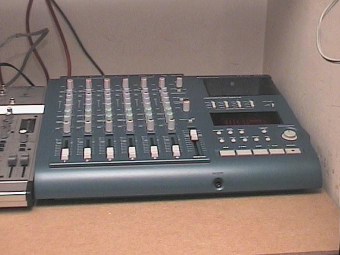
Here we have the Tascom 424 Mk III. It's a cassette tape based system with a built in 6 channel mixer, and it can multitrack. It has balanced and unbalanced inputs, high and low recording speeds, equalisation on all channels, Dolby noise reduction, and it is a very sophisticated recording system. |
![]() |
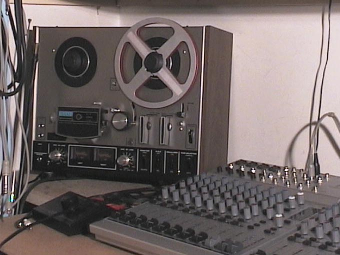
This is the reel to reel. It's an Akai, dual speed, full Stereo recording, and can be looped back into the mixing consol. Lower left is the output distributor which allows me to direct the final studio output to whichever resources I choose for final processing. |
![]() |
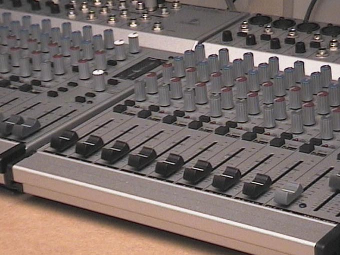
Part of the 32 channel stereo mixing consol. This is the main consol which is made up of two independent mixers, linked together to act as one, and has a multitude of features which makes it perfect for studio use, such as +48v phantom power for XLR balanced inputs, unbalanced and balanced low-noise inputs, equalisation on all channels, send and returns and pans and balances for each of the channels. |
|
I do have some custom electronic effects units that I want to design and build. These are for use with the guitar inside and outside of the studio. One such unit that I think would be very useful in shaping the sound of a guitar would be a graphic equaliser with at least four bands. Another project I have is to create some microphones of my own design and manufacture for the sole purpose of recording instruments. We also have the facilities to record with unlimited digital channels and tracks and perform all editing digitally for great quality and CD production. Plus we can do a final mixdown to most formats such as Cassette, Compact Disc, Mini Disc, Reel to Reel, MP3, or to digial resourses for editing and processing. Probably we will add DAT recording facilities at a later date. I am also looking at rack-mounting all the studio
equipment with a custom designed 19inch rack system. When I
look at the facilities and the equipment that I have now, I wish I had had
it back when I was playing in groups for a living. Our sound would
have so much different, and we would have been able to make our own CDs
and audio tapes for our fans to buy. |
![]() |
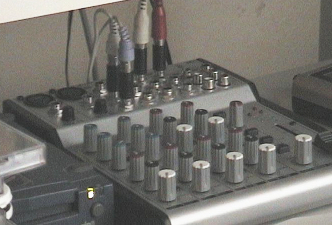
The baby of the studio. An auxillary but professional 12 channel full stereo mixer which has a bevy of features to make it a super little addition to the studio. Very useful for outside location work. Some of the features are equalisation and low-noise pre-amps on mic channels, plus +48v phantom power, FX send on all channels, pans and balances, plus more. This gets used quite a lot for routing various sources to the dedicated computer system where we process sound and have various multitrack digital recording systems at our disposal. This software includes Acid Pro, Cubase VST, Cakewalk, Sonar 2. |
![]() |
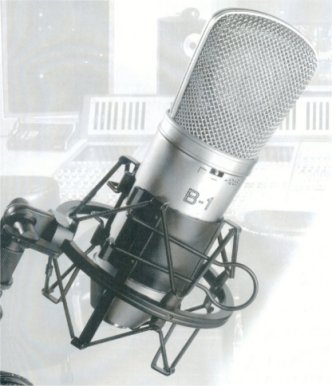
This is one of our +48v phantom powered Behringer condensor studio microphones. It is the B-1 and is great for recording vocals and instruments. The response is terrific and there is a marked difference between this microphone and our dynamic microphones. I remember well when I first connected this microphone up to the mixer and listened to it through the headphones, the reporoduction practically knocked me off my feet. Condensor microphones are prone to disliking moisture, and so they do require that extra bit of care when they are in use, transportation or storage. The finish on the microphone is excellent and it comes with windscreen, heavy-duty suspension unit, and complete in it's own flight case which is a very nice touch plus it's a good piece of protection for the microphone in both storage and travel. |
|
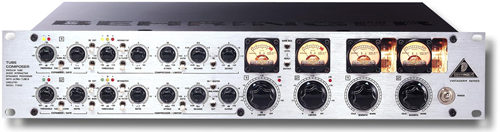
Above is the Behringer Tube Composer T1952. It's a dynamics processor and covers compression, limiting, gate, expander, and peak limiting. It really is a beautiful piece of equipment to just behold, and I am looking forward to doing some stuff with this. Apart from playing around with dynamics I can also add the warm of valves into a a recording. This is the latest addition to the studio and as yet I have not decided where in the chain it will go. I may use it as a final outboard or use it mainly for recording instruments. It's been too hot to work in the studio and put it through it's paces, but as soon as this damn heat goes down I shall be in there and working. |
|
Behringer Virtualizer Pro DSP2024P
The Virtualizer. The Behringer Virtualizer Pro DSP2024P to be precise. It is termed as a "High-performance 24-bit multi-engine effects processor". You have probably become aware by now that I like Behringer equipment. This particular 19-inch rack-mounted goody has some very exceptional features which is why I decided that this was a must for the studio. It can be used as an outboard for final processing or can be fed through the mixer's send and returns. This has stuff like reverb, delay, pitch, and so forth, but this also has amplifier and cabinet simulation and modulation effects/processing, plus a lot more. Like most rack-mounted studio equipment, the Virtualiser Pro can be MIDI controlled. It is also a full stereo device and can be configured through a setup option. |
|
The ZOOM RFX-2000 effects processor gives me really high quality reverb, pitch, chorus and modulation effects. A great 19-inch rack-mounted unit, easy to set up and easy to use. Can be installed easily to work with the mixer's send and returns. The input and output volumes can be adjusted, which is a very useful feature. ZOOM makes quite a lot of nice equipment, and I like this particular piece of equipment very much. |