Probably the most expensive parts of a valve amplifier are the speakers,
the output transformer and the mains transformers. I think it would go
without saying that the higer the power of the amplifier, then the more
costly are going to be the speakers and transformers.
The thing in favour of solid state amplifiers is the fact that you don't need output transformers, and of course they tend to be lighter in weight. One of the things that I find I don't like about solid state amplifiers is the buzzing sound you get when the guitar is too close to the amp or at a particular angle. Some of this buzzing is due to screening and earthing of the guitar pickups. On the other hand, a valve amplifier can be annoying in that the coils in the output transformer and chokes can sometimes act as a receiver - using the guitar lead as an arial - and pick up radio transmissions from taxis or police vehicles close by, which you could well do without when playing live somewhere. It could also happen through the coils in guitar pickups with the guitar lead acting as an arial. Not all guitars and valve amps suffered in this way.
I think that the worst thing we had to worry about with amplifiers, back in the sixties and seventies, was playing in clubs and pubs that had bad earthing in their electricity circuits. Les Harvey of Stone the Crows, back in the early seventies was electrocuted on stage due to bad earthing at a venue. I remember that I had a psychic vision a few days before Les was killed. In the vision I saw a guitarist in convulsion being electrocuted and unable to let go of the guitar and microphone, but I didn't know who it was. A few days later I saw the news report of his death on television. On stage, I have experienced electric shock from touching the guitar strings and the microphone simulaneously. I had friends who played in groups, and I remember one of them telling me how they literally had to kick the microphone out of the rigidly locked convulsed hand of a guitarist who was being electrocuted.
 |
 |
 |
|
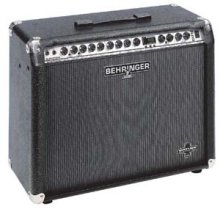
GX210 |
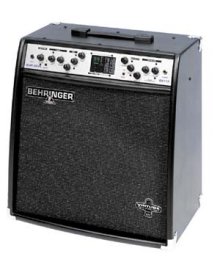
GX112
60-Watt 2-Channel Virtube Guitar Combo with Digital Effects costs £189 |
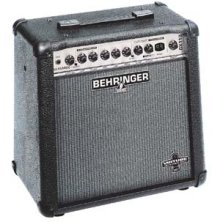
GX110
30-Watt 2-Channel Virtube Guitar Combo with Digital Effects costs £139 |
|
Three Behringer amplifiers, all solid state. From my experience of Behringer, the sound from their amplifiers is really good, especially if their BX600 Ultrabass is anything to go by, and I have no doubt that these would sound damned good too. Why not check them out and have a demo of them and then make up your own mind. I use quite a bit of Behringer gear in the studio, and Behringer equipment has never failed to impress me. What also impresses me is that none of these quality amplifiers would cost you more than £190 if you shop in the right place. |
||
Pushing a valve amplifier into distortion produces a somewhat musical sound as opposed to harsh distortion that you get from solid state. The valve amplifier has a warmer sound and can be misused more. Valves are easier to replace than transistors because you simply unplug the blown valve and plug in a new one, and you can't plug them in the wrong way. A nice accompaniment for a valve amplifier is a treble boost, and some of the distortion units that are available on the market. It is strange to think that for years the development of an amplifier without distortion took place, and now the thing seems to be to add distortion. Hey-ho such is life.
I must say that I like the amplifiers that were around in the sixties and seventies, most of them were valve amplifiers, and they had a look and a character of their own. Back then, valve amplifiers were not a rip off price-wise. Today you're looking at £800 upwards for a valve amplifier pushing 15 - 30 watts, who are they trying to kid. Most of, if not all, the valves that were around in the sixties and seventies are around today. They aren't that expensive either, nor are the mains and output transformers, especially when you consider what is paid for them when bought in bulk. It's the manufacturers of the amplifiers pushing up the prices trying to make out that valve amplifiers are something special. I've been inside a lot of the old VOX amplifiers. There is nothing complex in them and they are not complicated to build or wire up.
In all honesty I don't see how it can be justified, these days, to charge over £1000 for a VOX AC30 valve and speakers combination amplifier pushing 30 or so watts - even if it is a Class A amplifier. A solid state Fender amplifier pushing 65 Watts will cost you less than half that, and you'll get a great sound out of it. I tried the Fender Princeton 65 weighing in at £269 at the time and I was knocked out by the sound, I thought it was perfect for the guitar. To my mind, in present day, the valve amplifier stands for price extortion and price distortion, and this is my argument, they shouldn't cost that much with the actual costs of components and the time it actually takes to put one together.
If you really want to get that valve sound from a solid state amplifier, without paying too much, then there are add-ons such as an amplifier modelling unit. This is plugged into the amplifier and the guitar plugs into the modelling unit. Apparently this unit will synthesise most of the famous valve amplifiers and cabinet setups- and quite successfully too so I am told, but I couldn't confirm this as I haven't ever used one. Or you can go for a state-of-the-arts modelling amplifier, which would be my firm choice on the matter.
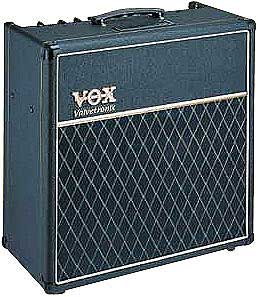
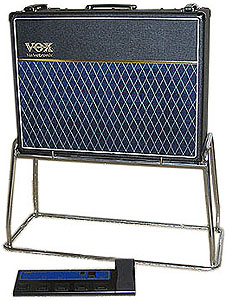
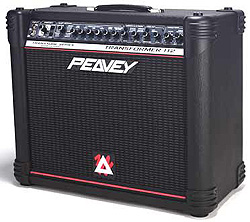
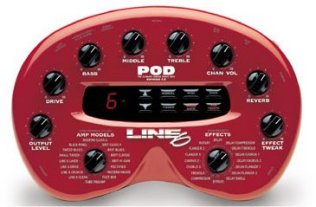
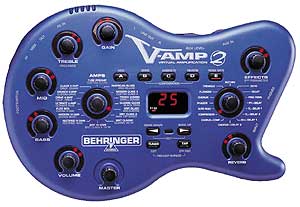
Have a look around the music shops. There are plenty of damned good solid state Fender and amplifiers, modeling amplifiers by Peavey. There are VOX ValveTronix modelling amplifiers that uses a valve amongst the solid state circuitry, and will cost you less than the amplifiers that it will very successfully model. You can also get guitar effects and amp modellers such as the Line6 Pod and Behringer V-Amp .
|
Some
modelling amplifiers
|
||
|
VOX
Valvetronix
|
Peavey
|
|
 |
 |
 |
|
VOX
AD60vt modelling amplifier
|
VOX
AD120vt modelling amplifier
|
Peavey
Transformer modelling amplifier
|
|
Guitar
FX and modelling units
|
|
 |
 |
|
The
Pod 2 will cost you about £185
|
The
V-Amp2 will be somewhere around £99
|
|
There
are guitar and bass versions of both the Pod and V-Amp, which also
come in rack mounting versions as well.
|
|
I've heard a lot of good things about the Pod and the VAmp, but I have never used one myself. I think I would like to try them out for myself next time I get a chance just to see if they are any good. I think, though, that if I were to get one then I would look at getting the rack-mounting version to go into my rack. From what I can make out you can download settings and presets to achieve the amplifier sounds of guitars such as Eddie Van Haylen, Carlos Santana, etc, from the manufactures website. On the face of it these seem pretty good value until they bring out something that is better, that you can't update your old unit to. What the possibilities are of updating your present units to latest ones are, I haven't a clue whether its possible or not.
Lets
face it £800.00 and above is stupid money for old valve amps, no
matter how good we think they were. These traders who sell them at these
exhorbitant prices can only do so if we are gullible enough to pay that
much. The trouble is there are plenty of people about who are prepared
to spend such money because they are gullible enough to believe the tripe
they are told. I like valve amplifiers but not at that price. In general,
I have found that I can get a good solid full-bodied sound from a solid
state amplifier. A very nice solid state jobby that I had at one time
was a Roland, which was originally used by a session musician who used
to play in one of my favourite recording groups. What a small world we
live in, and what an idiot I was to get rid of that amplifier.
The FAL Super 100 Watt with 15inch speakers that I had back in the seventies
was a solid state amplifier with 4 channels, volume treble bass and presence
on all channels, a damn good amplifier. You could quite easily improve
the sound of any of the solid state amplifiers made today. The thing is
they are usually produced with small speakers that can handle quite a
lot of power. If you were to rig it up such an amplifier with bigger twin
speakers of appropriate impedance, then you could dramatically improve
the quality of the sound. One of the down-sides that I have found with
solid state amplifiers is that they can have a bit of noise on the input
with some electric guitars, and this is often down to the pickups in the
guitar. This noise isn't so apparant with valve amplifiers although that
noise is still there.
To give
you an example of being ripped off. A VOX AC50, I had one in the early
seventies, I bought it second hand for about £35.00. New, it probably
didn't cost more than £80 - £100. I saw them being sold on
the Internet a while back for over £1400.00. Is that a rip off or
is that a RIP OFF. I have always thought that the VOX AC50 was a great
amplifier but I wouldn't pay that kind of money for it no matter how much
I like it.
I once had a VOX MkVI: V222 Teardrop guitar, you can see a picture of
it on my Past Guitars and Musical Equipment
page. I saw one very much like it, not so long ago, at a guitar supply
company.The guitar was somewhat battered and it would have been quite
a nice project to restore it. I made mention to one of the staff at the
establishment that I had a guitar much like it at one time and would be
interested in buying this one to restore. They tried to tuck me up for
£1500.00 pounds. Obviously they thought I would be prepared to pay
stupid money to get something that I showed interest in. Well, I wasn't
that interested, and I aint that stupid. I could have a reproduction hand
made for less. I bought my original VOX Teardrop in the very early 1970's
for £33.00 from the South Ealing Musical Bargain Center (which closed
down some years ago), does anyone remember that place - and Uncle Ernie.
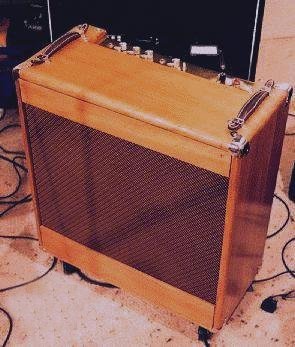
Those that want valve amplifiers would be better off building them. There are plenty of circuits available on the Internet for all the famous amplifiers, and the components and valves are available at reasonable prices. Maplin still does the valves you will need, and there are other outlets too. Have a look at the Lutherie and Stuff page that is on this website, that will give you access to a whole world of building amplifiers and the results that other people have obtained. I have seen some of the work that other people have done building amplifier and guitars...terrific.
On the right is a home-built Bassman amplifier, made by John Edwards. It's a valve amplifier, and it's a good example of what can be made if you put your mind to it. Plus it shows the kind of dedication that people have when it comes to making something. If you click on this picture it will take you to a site where you can see more about the building of it.
People seem to think that you need a lot of power to high levels of amplication. It's the quality of the speakers that matters more. It was remarked to me quite a number of years ago that Wembley Stadium only used 10 watts on its public address system, and that it was the quality of the speakers that did the rest.
You might also find the AX84 Project pages interesting too. I'm not going to tell you anymore about it, so go and have a look for yourself - so there!